
Mental age gets used in two very different ways, and that’s where confusion starts. Some tools aim for a playful read on maturity, habits, and emotional style. Other systems use brain imaging to estimate “brain age” as a health signal.
AI-Based Analysis to Know Mental Age usually sits closer to the first category for most people: a vibe check on how thoughts and reactions look compared to typical age patterns, not a clinical verdict.



Interest makes sense. Mental age can feel more accurate than a birth date on days when stress, routines, and priorities land differently than expected. Still, wording matters because mental age, brain age, and intelligence testing are not the same thing.

What Mental Age Actually Means
Mental age originally came from early psychology work, including Alfred Binet’s early 20th-century testing approach for learning support. In that historical context, the idea tied to cognitive performance compared with age-based averages, which later influenced intelligence testing.
Modern “mental age” online usually blends two buckets: cognitive maturity (planning, learning, problem-solving) and emotional maturity (self-control, empathy, conflict style). Most app-style results land closer to personality and self-reflection than measurement science.
Mental age also moves. A rough patch, poor sleep, burnout, or isolation can drag decisions toward impulsive patterns. Stable routines and healthier coping can shift behavior toward calmer, more deliberate choices.
How AI Tries To Estimate Mental Age
AI systems don’t “see” maturity directly. Patterns get inferred from answers, tasks, or scans, then compared against training data. Accuracy depends on the data quality, the model, and the goal of the tool.
Quiz-Style Tools and App Scoring
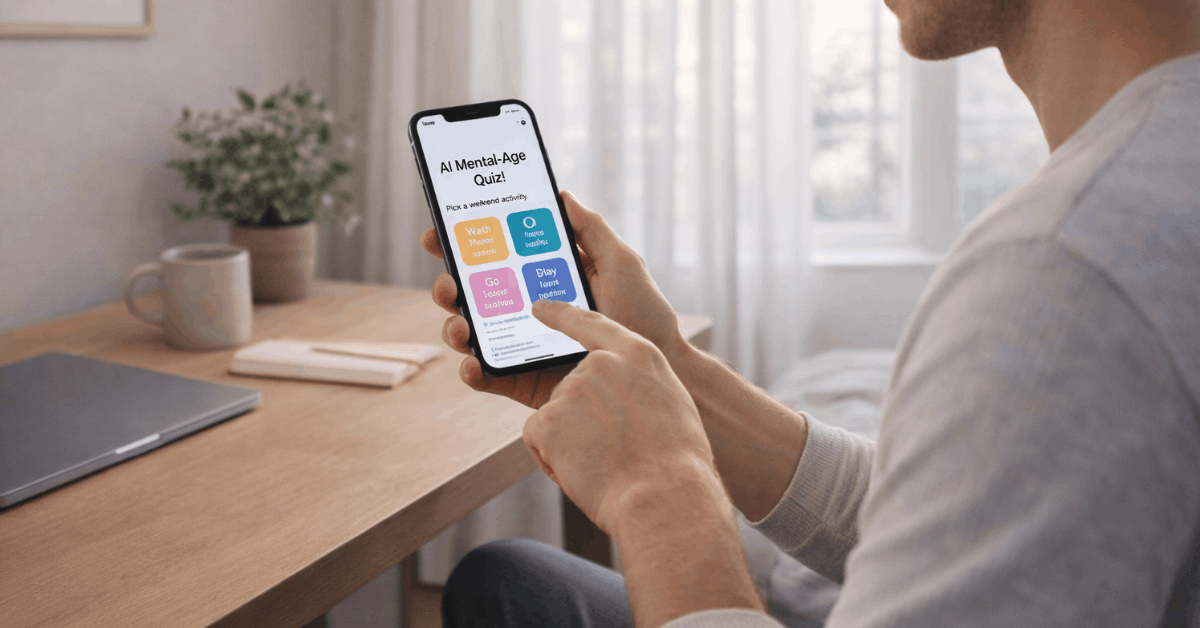
Many tools run like a mental age quiz with AI, using scenarios about stress, mistakes, conflict, and planning. Answers map into broad buckets such as “Young Explorer” or “Old Soul,” which can feel relatable even when the scoring is simplistic.
An AI mental age app often adds engagement hooks: fast results, shareable labels, and bright category names. Entertainment design can be useful for reflection, yet it also nudges people to treat a label like a diagnosis.
Brain Age Models Using MRI
Researchers also train neural networks to estimate brain age from MRI scans by learning age-related patterns in gray matter and white matter. Many papers discuss the “brain age gap,” meaning the difference between predicted brain age and chronological age, as a potential biomarker linked with later cognitive risk in some populations.
Peer-reviewed work in outlets like PNAS and newer reviews in 2025 discuss the promise, while also noting limits and variation across methods.
Clinical usefulness remains uneven. A 2026 comparison in a major medical journal reported meaningful differences between software packages, plus weak links to future memory change in some settings, which is a reminder that “brain age” is not a clean scoreboard.
Psychological Aging Clocks
Some platforms go after subjective well-being rather than MRI. Deep Longevity’s Mind Age tool and the Young.AI platform have described a psychological age clock approach, mixing questionnaires and cognitive tasks to estimate psychological aging and resilience trends. Public-facing materials also stress that these tools are not diagnostic.
Entertainment Results Versus Clinical Signals
Most “mental age” tests in app stores are entertainment. That matters because entertainment tools prioritize fun categories, not medical accuracy, and usually skip the safeguards expected in healthcare.
Clinical or research tools behave differently. Brain-age modeling, cognitive screening, and dementia risk research typically sit inside regulated settings, clinician oversight, and peer-reviewed methods. Even then, experts treat outputs as one data point among many, not a stand-alone conclusion.
A clean rule helps: entertainment mental age results can support reflection, while clinical concerns should route through qualified professionals, especially if daily functioning changes.
Quick Mental Age Self-Check Quiz
Honesty beats perfection here. A short quiz can highlight patterns tied to emotional regulation and decision style, which is closer to what most people mean by mental age.
- Stress response: A) panic and feel overwhelmed (1) B) manage it but struggle (2) C) use coping strategies (3)
- Learning new things: A) avoid it (1) B) try, but it’s challenging (2) C) enjoy seeking new knowledge (3)
- Conflict handling: A) avoid confrontation (1) B) discuss i,t but it’s difficult (2) C) address issues constructively (3)
- Emotional expression: A) bottle it up (1) B) express it awkwardly (2) C) communicate feelings openly and healthily (3)
- View of failure: A) see it as a setback (1), B) learn from i,t but it’s hard (2,) C) treat it as growth (3)
Score totals: 5–8 suggest a more impulsive or reactive stage right now, 9–12 suggest balanced functioning, 13–15 suggest higher consistency and emotional control. Results can be reframed as an emotional maturity score, not a permanent label.
How To Interpret Categories Without Getting Trapped
Mental-age categories are broad on purpose, so treat them like a mirror, not a measurement. A “young” result can signal openness, playfulness, and high energy, plus weaker coping under pressure. A “mature” result can signal stability and perspective, plus a tendency toward rigidity.
Two common self-stories show up fast: a young at heart mindset and an old soul personality. Both can be healthy, depending on context, work demands, and support systems.
Intelligence is a separate topic. IQ tests such as WAIS or Stanford-Binet have standardized designs, while most mental-age quizzes do not. A person can score high on reasoning and still struggle with emotional regulation, or the reverse.
Factors That Can Shift Mental Age Over Time
Change tends to follow inputs, not labels. Growth shows up through habits that improve emotional control and clearer thinking under stress.
- Sleep consistency and stress management often improve judgment speed and patience.
- Social connection and conflict practice can raise empathy and communication skills.
- Learning routines builds flexibility, especially under deadlines and feedback.
- Movement, nutrition, and chronic-condition management matter for long-term brain health, and research links metabolic factors to faster biological aging trends.
- Purposeful challenges, like mentoring or skill-building, strengthen cognitive resilience habits over time.
Privacy, Bias, and Safety Checks For AI Tools
Data collection varies widely. Some apps store responses, device data, or behavioral signals that can be used for profiling or ad targeting. Terms and privacy settings deserve a slow read, especially around data sharing and deletion.
Bias also matters. Training data can over-represent certain countries, languages, education levels, and cultural norms. A tool can misread bluntness as immaturity, or quietness as emotional control, depending on the dataset and question style.
Health-related claims need extra caution. Brain-age tools, dementia-risk language, and “clinical-grade” marketing should be backed by peer-reviewed research and used under appropriate oversight, not treated as self-diagnosis.
Last Thoughts
AI-based mental age analysis typically provides a developmental snapshot rather than a clinical finding. Quiz-style tools can support reflection, while MRI-based brain-age research aims at biomarkers that still carry real limitations and variation across methods.
Concern about memory, confusion, personality change, or daily functioning deserves professional assessment, especially when symptoms persist.