
Curiosity around an AI IQ Test has shifted fast since 2025, mostly because a few public score trackers now show frontier models landing in the “genius” band on popular online tests.
A typical human IQ reference point is 100, while 130+ corresponds to the top 2%. Numbers like that sound definitive, yet the details matter, especially test format, exposure, and what the score is actually measuring.



What an AI IQ Test Measures and What It Misses
AI IQ tests are attempts to map machine performance onto human-style cognitive tasks. The idea sounds simple, but it gets messy quickly. Many IQ-style benchmarks reward fast pattern completion and rule discovery under time pressure, which lines up well with how language models optimize for structured problems.

Scores often reflect fluid intelligence more than everyday intelligence. Pattern recognition, short-horizon reasoning, and clean logic chains show up strongly. Open-ended judgment, embodied common sense, and social context either show up weakly or not at all, depending on the test.
A big caveat sits underneath nearly every headline number. Online puzzles tend to leak into training sets indirectly, so performance can improve without “understanding” improving in the human sense. That’s where skepticism stays healthy.
What The Current Scores Really Say from 2025 To 2026
Public charts that rank models on popular tests often cluster top systems around the low-to-mid 130s, at least on certain online exams. Tracking dashboards based on public tests have circulated widely, sometimes republished as infographics, and they commonly frame 130+ as “genius.”
The more important takeaway is not the exact point estimate. The bigger story is the gap between text-heavy reasoning and vision-heavy reasoning. Several studies on visual IQ-style benchmarks suggest modern multimodal systems still stumble on basic perception and structured visual puzzles, even while text reasoning looks impressive.
Another wrinkle: plenty of these numbers come from a single test form. A single instrument can overstate generality, since strengths can be narrow and brittle. That brittleness tends to show up when prompts shift slightly or when the puzzle type changes.
Take The Same Test and Compare Fairly
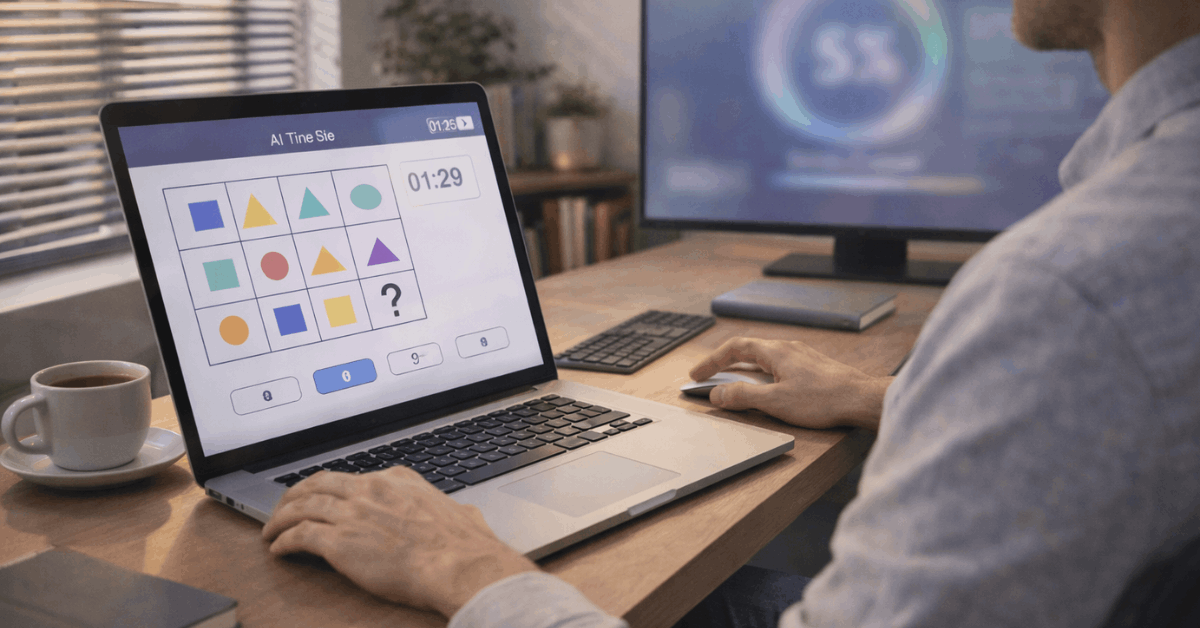
A fair comparison needs consistent conditions, since timing, device, and retakes can skew results. Two tests show up repeatedly in public conversations because they map cleanly to pattern and reasoning tasks: the Mensa Norway IQ test and Raven's Progressive Matrices.
A clean approach keeps it simple and repeatable:
- Pick one test and take it once, without pausing.
- Record the score, time, and any interruptions.
- Wait at least a week before any retake, if curiosity remains.
- Compare the score to the 100 baseline and the 130+ benchmark.
- Treat the result as a snapshot, not an identity label.
The 130+ comparison point is useful mainly because it’s the range many public trackers cite for top models on certain online tests. Reaching that band suggests strong pattern reasoning, not automatic superiority in every domain.
Why Models Can Look Like Geniuses and Still Feel Odd In Real Life
Four factors explain the “genius score, goofy behavior” effect without any mystery.
- Speed and scale come first. Models can brute-force variants mentally, keep many possibilities active, and compute fast. That makes timed puzzles look easy.
- Second, novelty is a real wall. Many failures show up on out-of-distribution problems, meaning tasks that don’t resemble what the model has seen during training or tuning. Humans often generalize better when a puzzle is genuinely unfamiliar.
- Third, perception is still shaky. Weak visual reasoning can drag down performance on visual IQ formats, especially ones that rely on tiny geometric differences, spatial relationships, or clean visual parsing.
- Fourth, real-world commonsense remains inconsistent. A system can ace formal patterns while still making basic physical errors, because physical understanding is not guaranteed by text prediction alone.
How To Read Your Score Without Overreacting
A single score can tempt the brain into overmeaning it. A more grounded read keeps three questions in view. Test validity matters. Many online tests openly state they are not substitutes for supervised professional testing. That does not make them useless, but it caps how much confidence the number deserves.
Exposure matters. If a test is widely shared online, training data leakage becomes plausible, especially for models trained on large web corpora. That can inflate scores without proving broad intelligence.
Consistency matters. One good run can be luck, pattern fit, or a strong day. A stable pattern across time, across test forms, and across puzzle types carries more meaning.
A Better Way To Compare Yourself To AI
An IQ-style score can be fun, but it only covers a slice of cognition. A broader comparison looks at multiple skill surfaces and checks for brittleness.
ARC-style tasks are often brought up for this reason. ARC-AGI and related work focus on learning new rules from tiny examples, then applying them to new grids. This kind of challenge is often framed as an AI benchmark for generalization under constraint, since memorization helps less and abstraction matters more.
That does not mean ARC results convert cleanly into an IQ number. It means the comparison becomes more honest: pattern completion plus adaptation, not pattern completion alone.
Practical Limits and Ethics Worth Keeping In View
A few practical limits keep the topic from turning into hype.
- Online scores are estimates. Many are not peer-reviewed, and test conditions vary wildly across users and models. Public dashboards can still be useful for trends, yet “official IQ” language is usually overstated.
- Linear growth assumptions are fragile. Some commentary extrapolates a steady monthly increase based on short windows of progress, then projects dramatic future scores. That can be interesting as speculation, yet it is not the same thing as a validated forecast.
- Ethics matter too. IQ framing can encourage shallow ranking behavior, especially in workplaces or schools. Intelligence is not one number, and a single score can hide more than it reveals.
Conclusion
Treat an AI IQ score as a narrow snapshot, not a verdict. Compare under the same rules, record context, and resist overinterpreting a single run.
Prioritize tests that minimize exposure effects and check generalization rather than memorized puzzle types. Keep ethics central: scores can guide curiosity, while real capability is demonstrated in practice.